Showing posts with label Integration. Show all posts

Thursday, April 6, 2017

Sport in Education

Last Thursday I was lucky enough to be in Wellington (on behalf of NZATE) with staff from the 24 schools who take part in the Sport in Education initiative.
These schools deliver curriculum in a variety of ways that take sport as a context or sporting values as a way of shaping education. Teachers came from mainly Health and Pe, English, Maths, Science and Social Science fields. I spent a large part of the day with a group of English teachers sharing how English worked in the programme in their schools.

The day began (after a wet and wild flight up the island) with a high energy key note address.

Key Note: Susie Stevens (a few notes) 

One size does not fit all - the danger of standardisation. 

Trapped by the barriers, of language. 
Guided by the language we use to define education - GATE, reading recovery , accelerated, special education. Always trying to get back to the norm. But what is actually the norm? 

Change in education is not easy - change is compared to death - there's grief (Kubler Ross) 

Is it possible to get change in education without a cape and undies? 
- there's needs to be a reason for the change
- resist labelling those on board and those not- empathise not criticise 
- need systems to support 


Change is hard -as the Child President reminds us 

It's hard to break out of subject silos - but we need to remind ourselves of what is the vision of the curriculum document?

Think about the skills a 'Bomb disposal technician'  - Bomb technicians learn how to engage in effective communication, analytical thinking, teamwork and individual work while under stress and in dangerous conditions. 
These could come from many of our curriculum statements.

What about the jobs that don't exist? Do kids hate Maths? Or hate the fact that they don't understand it? Or it is in no context? 

Differences and 'sameness' 
We cultivate a culture of sameness 
- for ease 
- for power 
- we've always done it this way

If a flower doesn't grow, do we blame the flower? 
Who/What do we blame - the environment.
We want students to grow, get the right environment. That's what we are in charge of and what we are charged with doing - creating the right environment. 

English Subject Cluster - some shared ideas 
- many changes
- focus on active learning - not just sports active learning - making pens
- start small
- mainly junior schools
- end of year all buy in - all subjects - Olympics - bringing outside in as well 
- target a Yr11 focus class 
- literacy based inquiry 
- learning to learn behaviours - creating a community with values - team culture 
- theme based units 'the big deal' healthy community - move towards a more integrated approach 
- change in class attitude but teacher collaboration has been great 
- Yr 11 kayaking - trip to Waitangi included history and English - all work done by all kids across all subjects 
- all boys schools / all boys classes 
- follow a team/competition - history, most expensive player etc Euro16
- speech on their chosen sport on how to get to the elite level in their sport 
-  'the best year teaching of my life' 
- a privilege to be part of this class 
- Eng/PE/Maths - issue of the timetable allowing this 
- active learning - mini teams - building a culture - build in an expedition for this - round the campfire 
- similar language across the classes -eg energisers - integrated assessments 
- why do we lose the 'learn through play' 
- high technology 
- all teachers involved in all activities - teachers build the relationship 
- science of meta-cognition 
- 4 week training with military trainer 

How do we create an environment that allows our learners to do the best that they can do? A shared context? How do we translate to NCEA? 
- active education 
- parts of speech relays
- scavenger hunts for revision 
Level 1- teachers meet every week around the class - shared approach - shared values through sport - great for English text choices 'the body's response to exercise' - needs to be timetabled as a cohort

After a great day, I'm pretty keen to get my own school involved! 


Tuesday, March 24, 2015

Choose your own adventure - Australian Science and Mathematics School

The Australian Science and Mathematics School (ASMS) is focussed on providing a vibrant, future focussed curriculum for students who have a passion for Science and Mathematics. 390 students through Yr 10-12 (our 11-13) choose and pursue their own adventure in open plan, flexible, colourful and unbelievably quiet spaces. 80% of the students go onto tertiary studies.


Pillars and coloured seating are used to delineate individual spaces within the whole - the pastoral teams have 'team areas' for Learning Studies - the pastoral care curriculum. Purple seating designated non assigned areas in all spaces.  The design will look familiar to those of us who have visited Albany Senior College, Ormiston or HPSS, as ASMS hosts many visiting educators. Part of their school 'brief' is to 'support educators in changing their practice,vimproving student learning.' 

Two students to me in a tour of the school, which covers two floors and an aviation lab in the adjoining Flinders University Campus. As I mentioned earlier, one of the things I noticed was the 'quietness' of the space during the learning times. During recess and lunchtime, the noise level rose considerably. Another thing was that the teacher spaces were fully open to the student spaces, unlike the models we have seen in NZ. If needed, there were rooms where quiet conversations could take place. 

the green team teacher space 

The curriculum is divided into Yr10/11 and Yr12. Unlike us, Australia has only one level of national examinations, in the final year of school. Which makes the system very high stakes. However, this affords a deal of flexibility in the two years prior to this. I guess this was the school with the curriculum that most resonated with me - not just the integrated thematic approach to Yr 10/11. but also the formalised pastoral care curriculum. 

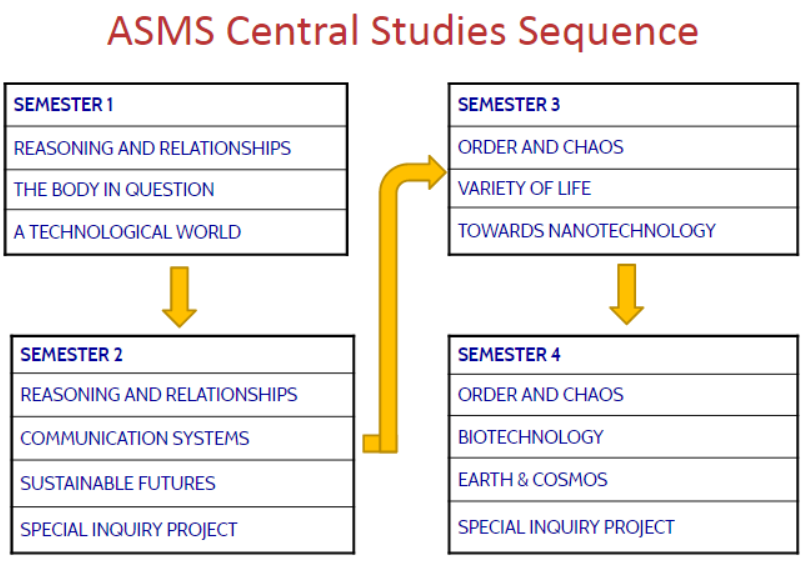
For set periods of the day the Yr 10/11 students work in mixed groupings on 'central studies'. Over the two years they cover 8 broad themes, which focus on real world problems and include 'new sciences.' The slide below is from a presentation shared with me by Andy Stone, one of the schools Deputy Principals - showing the broad themes for the Central Studies courses. 

 Each topic has a 'Fertile Q' - which is then worked on collaboratively by a group of up to 12 teachers. Most are involved facilitating central studies, but Languages, Drama and Music are addressed in 'Adventure Space Time'. The question drives ;the feel' of the unit - then the teachers will decide how the specific aspects of curriculum delivery will be addressed or approached. There is responsibility for curriculum checkpoints and assessment checkpoints within the group. Teams are built around expertise and who would work well together - a balance is created between who creates what work and between teachers' individual contexts and delivery.
Below is an example of a 'fertile question' and the curriculum contexts that evolved from it.

The Fertile Question


The disciplines that sit underneath the fertile question are essential for mapping the curriculum. The 4 central studies are designed so that the essential elements of Science and Maths are covered across the two years. This programme was not designed overnight - Andy mentioned that it had taken a number of years to get these programmes 'right'. One of the key benefits, apart from student engagement, was the time saved working in teams, the willingness of staff to share - but also be prepared to see things change. Understanding by Design (Jay McTighe) provides the framework for unit design, and all documents refer to this planning framework One of the big shifts is that assessment also needs to be interdisciplinary as well. He asked the question - if the kids are learning, do the need to be assessed all the time? I must say that most of the schools I visited were aghast at the fact we had a 3 year examination system.


Central studies form only part of a Yr 10/11 timetable -Adventure Space Time (individual - choose your own adventure topics) and Learning Studies Groups, make up the rest of the timetable. 


Learning Studies Group is the formalised pastoral care programme. The students are divided into 4 teams (designated by colour). Each group had no more than 18 students, and one tutor, and a team leader. An overall Learning Studies Leader coordinator developed the programme in conjunction with the 4 team leaders. Term 1's programme was about making ASMS 'work for me'. These sessions were 40 minutes a day. As well as the structured programme helped monitor and map each students individual curriculum plans  linking to their academic . Sometimes the groups regrouped into Yr levels. Term 2's programme revolves around the neurosciences. Lots of planning time was provided to ensure that this programme ran smoothly. 


Toby and Sion, my student tour guides, talked extremely passionately about their time at ASMS - but it was not all rose tinted glasses! Interestingly the commented on the things they'd like changed in the labs! More sink spaces, as it was annoying to have to wait to wash gear! They felt that they could be a lot more independent at complete work stations. 
I wonder if we have asked our students about this! Both students were taking Psychology as a major - but as ASMS (and I presume South Australia, it sits under the Science, not Humanities umbrella. They reiterated a number of times, that what they valued the most, was the fact that there were no boundaries to what you wanted to learn. An 'innovation space' on both the timetable and in a physical space, allowed students to follow a personalised project - for which funding was available, if required. They also liked the fact that formative assessment work was not compulsory - as students were at different stages - if you needed to do it, you did. They saw this as ultimate differentiation!

For me the innovative curriulum design; collaborative team teaching approach and the focus on Learning Coach model of pastoral and academic care were the key. Obviously the building and learning spaces were impressive. Part of the school's founding philosophy is that they are tasked with providing professional learning opportunities for their own staff, local staff, regional staff and international staff, like myself. 

Thanks ASMS team for your time and willingness to share ideas and resources. 

Thursday, March 12, 2015

Case Study - Paul Whitehead - letters from a small stage

An fascinating and  interesting look at a small school doing something amazingly different - Bold Park Community School - http://www.boldpark.com/

Philosophy 
Reggio inspired - http://www.education.com/magazine/article/Reggio_Emilia/
100 languages
Environment 
Nature based 
Socio constructivist
Respect ( no discipline policy)

What you'd see at Bold Park
Every class is multi range - 3 levels right up to Yr 12 
No bells
First names - all teachers all students 
40% of class time spent outside
No shoes except for sport and science lab
Outside play spaces  - lots of freedom - fire pits, no internal fences 
Staff write a personalised letter to every student twice a year
Half a day professional development a week - close early every Weds
2 teachers in every room - 1 trained, 1 in training 


Paul recognised that it is Hard to break down the silos of the secondary school - however as a school they were determined to do - this became the forensics unit - including the collaborative writing of a novel over a 3 month period - http://www.boldpark.com/home/?currentPage=2

'Positive Girls' - fabulous Health, Media and English based unit 

Total belief in the need for community involvement! 


Wednesday, March 11, 2015

Networked Learning Communities of Practice - Learning Frontiers Group

This session was one of my favourite ones today, because of the specific case study from an amazing group of school leaders and students from Campbelltown Performing Arts College. 

The key message was that learning  needs to be co- created; connected; personalised; integrated. They are part of a community that has formed clusters of schools - teaching, learning and assessment based on the 4 principles  - I guess this is the IES communities of practice model?

It is clear that focussing on literacy and numeracy is not enough - what you can extrapolate from what you know is more imp than what you know.
What are we doing to prepare students for the future?

The idea that many students are un-engaged - not just disengaged - is problematic. Agency is the way to reverse that. Many schools fail to give the students agency over their learning - agency is much more than student voice - students with agency are 24/7 learners 

Passion projects - enigma missions - same name really - what youngest to learn!  Authentic problem solving, real world issue - a key theme was providing a community focus. This echoes the work of HPSS and Alfriston in Auckland.

What do we mean by engagement? I liked these definitions 
Academic engagement- commitment to all school work and study
Social engagements - outside of the normal curriculum often more impt 
Intellectual engagement -serious emotionalcognitive investment in learning 

Engaging learning is - 
Integrated - how do we harness the power of students' social contexts to deeply engage them in learning  
Connected - how can student learning result in valuable products and services - community project in second semester - real world contexts 
Co created - how does completely open and shared learning lead to engagement of all stakeholders - blog learning journal daily - opening up the classroom environment 
Personal - what happens to people like me ? 

Deepening engagement through inquiry - the need to be outward looking - are we achieving what we think we are achieving - use the technology to overcome  the tyranny of distance
The design thinking process essential.

Leadership and Governance Model  - leadership says 'yes, do it', a middle tier hub looks at what it might look like, working parties investigate how we do it. 

Technology enables  engagement in deeper learning to meet the 4 dimensions


Case Study - Campbell Performing Arts High School - Learning Frontiers 
The term brave has been used a number of times to describe staff who are changing pedagogy to engage students more actively in their learning.
What does this look like 

School Level - this is the action research/action learning model - empowering teachers and respecting expertise - research in our own context
- it's ok to fail 
- teacher collaboration - pedagogy not content
- evaluation all the way through 
- evidence based classroom practice 
- if our teachers can do it with our kids in their classroom, all teachers can 
- more regular feedback loops - if we're heading didn't he wrong path, we need to move on earlier
- identify promising practice early 

Teacher - Team Level
- plan develop collaborate team-teach integrated content
- connections across subject areas led to deeper classes - Eng/Science
- authentic nature of content
- partnership with local
- 3x3 subjects - self regulate; collaboration across learning areas

Student Level
- connects with and uses real world contemporary issues 
- supporting teachers to be better at what they do
- 3x3 Eng Mus Art 
- online one note - tracking across the subjects 
- personalised approach - build on student passions - foster individual talents
- can work in allocated cluster groups 


Co - creation 'voice and choice' - the best phrase yet!!

A great presentation - 


Friday, August 29, 2014

The journey - MLE and P - Meeting 2

Key Questions
What is the endgame? Where will the heart of the school be? What is the quality heart space?
What happens to the spaces between the new build and existing buildings ? Flow across the school - where will the central entrance be? How do the memorial trees locate in this? Do we move the memorial trees ?

How do students flow through the building?

Connecting the old and the new - 


How do we get the old and new to 'interact?' - Ministry driver is the provision of teaching spaces - not what goes into the commons. 

Relocatables 
What will KBlock look like? How many science labs? Will there be space for staff work in the 'transitional build?' 
Science have produced a detailed plan of what it could look like. 

Legoland - Jasmax model 

Possible footprint - very early working drawings - collating ideas 


How do we want a student commons to integrate to the rest of the school around it - between Arts and Technology?

The pedagogy 
Focus on an integrated junior curriculum - with specialist electives out of the building - senior Science then brought in.

The pedagogy has to match the space.


Good question - What will a big glass space be like on a hot North Canterbury day? High ceilings and top line heat radiation. 

The learning whare - simple clean lines - make it more interesting inside. 


Friday, August 8, 2014

Small module - Sci + Eng combo


Having to do some work with the kids ....


Starting point - what keeps you awake at night?

Science and English AOs drive the programme.

Debunking the myths of what poets and scientists look like!!


Student in collaborative work and feedback  - team teaching 


Some students at high tables - their choice. 


Natural transition between English and Science - in the conversations!

Conversation around flax linked to the whakatauki -

Range of seating options - 


Sharing in the circle - most important thing in your life .....


.....eek visitors have to answer too.....,
 Interesting responses from this Yr 9 group :
- family
- freedom - to think and day what I want 
- ecosystem
- existing
- relationships
- success 
- being the best
- active and enjoying and contributing
- honesty- true to yourself
- learning - wanting to build something better for myself and the people around me 
- people - who make me happy  - give me purpose 

English focus is on speaking - because that is the AO for the unit 

Which of these - poet, philosopher or scientist had had the most impact on your life?
Mini inquiry-a least one must be a female.
All individual inquiry for the rest of the day.

Next week 'hot air debate' - only 1 of each will be left in the balloon when it drops to earth?

What are the mini questions that we have to find out? 
-Who?
-Why?

"I made Einstein my wallpaper"